


Introduction: The Critical Component in Fluid Systems
A ball valve works by rotating a spherical ball with a drilled hole to control fluid flow. When the bore aligns with the pipeline, the valve is open; when rotated 90 degrees, the solid portion of the ball blocks the flow, providing tight shut-off with minimal pressure drop.
Understanding how a ball valve works is essential for engineers, maintenance teams, and procurement professionals involved in industrial fluid systems. While ball valves are often perceived as simple on/off devices, their internal design, materials, and configuration directly affect operational safety, efficiency, and total cost of ownership.
This guide goes beyond a basic explanation. It combines engineering-level technical insight with practical sourcing and lifecycle considerations, helping both engineers and buyers make informed decisions.
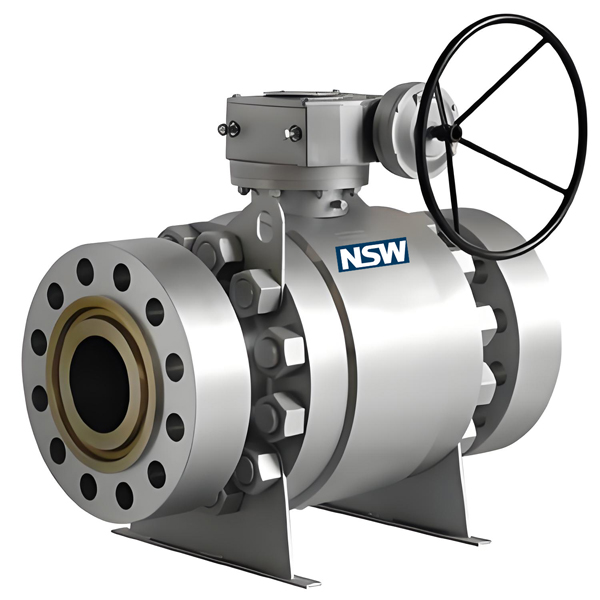
How Does a Ball Valve Work? (Working Principle Explained)
A ball valve operates on a quarter-turn working principle:
-
Open Position
When the handle or actuator is aligned with the pipeline, the ball’s internal bore is in line with the flow path. Fluid passes through with minimal turbulence and pressure loss. -
Closed Position
Rotating the handle or actuator by 90 degrees turns the ball so that its solid side blocks the flow. The downstream seat is pressed tightly against the ball by system pressure, creating a pressure-assisted seal.
Engineering Insight:
The operating torque of a ball valve is not constant. The highest torque occurs during the initial breakaway (“break-to-run torque”). Accurate torque values provided by the manufacturer are critical for correct actuator sizing and long-term reliability.
Ball Valve Design and Selection Guide for Industrial Applications
The reliability of a ball valve comes from its robust mechanical design, but performance varies significantly depending on construction details and material selection.
Core Components and Material Considerations
Valve Body
The body serves as the primary pressure-retaining component. Common materials include carbon steel (WCB), stainless steel (316), and duplex stainless steel. Selection depends on pressure class, temperature, corrosion resistance, and cost.
Sourcing Note:
Always verify Material Test Certificates (MTCs) in accordance with ASME or ASTM standards.
Ball
The ball contains the flow port and rotates to control flow. Surface finishes and coatings such as hard chrome plating or ceramic coating improve wear resistance and reduce galling.
For control applications, V-port balls provide improved throttling accuracy compared to standard round-port designs.
Seats
Seats create the seal between the ball and valve body. Common seat materials include:
-
PTFE / RPTFE: Low friction, suitable for most services
-
PEEK and advanced polymers: For higher temperatures and pressures
-
Metal seats: Required for abrasive or high-temperature services
Fire-safe ball valves must comply with API 607 or ISO 10497 standards.
Stem
The stem transmits torque from the actuator to the ball. A blow-out proof stem is a critical safety feature. Multi-ring graphite packing with live-loading springs ensures long-term sealing and reduced fugitive emissions.
Types of Ball Valves: Full Port, Reduced Port, and Trunnion Mounted
Selecting the correct ball valve type is one of the most important technical and commercial decisions.
| Feature | Full Port Ball Valve | Reduced Port Ball Valve | Trunnion Mounted Ball Valve |
|---|---|---|---|
| Bore Diameter | Equal to pipe ID | Smaller than pipe ID | Full or reduced |
| Key Advantage | Minimal pressure drop, piggable | Compact, lightweight, cost-effective | Low operating torque |
| Pressure Drop | Negligible | Moderate | Low |
| Typical Application | Pipelines, pumping systems | General industrial service | High-pressure, large-diameter lines |
| Sourcing Perspective | Higher initial cost | Best value for standard duties | Higher unit cost, lower actuator cost |
Engineering Note:
Trunnion-mounted ball valves support the ball at both ends, reducing seat load and operating torque, making them ideal for Class 600+ and large-diameter applications.
Common Ball Valve Applications
Due to their tight shut-off, fast operation, and low maintenance requirements, ball valves are widely used across industrial sectors:
-
Oil and gas pipelines
-
Chemical and petrochemical processing
-
Water treatment and desalination
-
Power generation systems
-
Food, beverage, and pharmaceutical processing (sanitary ball valves)
The optimal ball valve design depends on media type, pressure, temperature, cycle frequency, and safety requirements.
Manual and Automated Ball Valves
Manual Ball Valves
Manually operated ball valves use lever handles or gearboxes. They are simple, economical, and suitable for infrequent operation.
Automated Ball Valves
Automated ball valves use electric, pneumatic, or hydraulic actuators for remote or frequent operation.
Procurement Tip:
Ensure compatibility between the valve and actuator mounting interface, typically per ISO 5211 standards.
Specialized Ball Valves for Specific Functions
-
V-Port Ball Valves: Designed for flow control and throttling
-
Multi-Port Ball Valves (3-way / 4-way): Used for diverting, mixing, or switching flow
-
Low-Emission (LE) Ball Valves: Engineered to reduce fugitive emissions and comply with ISO 15848
For low-emission applications, certified test reports should always be required during sourcing.
Installation, Maintenance, and Lifecycle Cost Considerations
Installation Best Practices
-
Isolate and depressurize the pipeline before installation
-
Ensure proper flange alignment without forcing
-
During welding, protect internal seats from excessive heat
-
Use protective caps during transport and storage
Maintenance and Troubleshooting
-
Cycle valves periodically to prevent sticking
-
Inspect stem packing and body seals for external leakage
-
Internal leakage typically indicates seat or ball damage
-
Maintain critical spare parts for high-importance valves
Lifecycle Cost Analysis: Beyond Initial Price
From a procurement perspective, ball valve selection should be based on Total Cost of Ownership (TCO) rather than unit price alone:
-
Acquisition Cost: Valve, actuator, accessories
-
Installation Cost: Influenced by size, weight, and complexity
-
Operating Cost: Pressure loss, energy consumption, maintenance
-
Risk Cost: Downtime, safety incidents, and failure consequences
Conclusion: Aligning Engineering Requirements with Strategic Sourcing
Ball valves may appear simple, but their performance is the result of careful engineering and informed selection. Engineers must clearly define operating conditions, while buyers must evaluate long-term value using lifecycle cost analysis.
As industrial systems evolve, smart and sensor-enabled ball valves are becoming increasingly important for predictive maintenance and digital integration.
By combining a solid understanding of how a ball valve works with strategic sourcing practices, organizations can achieve safer operations, improved reliability, and maximum return on investment.
Other Tips:
Floating Ball Valve
Ball Valve vs. Gate Valve
Ball Valve vs. Butterfly Valve
The top ten Chinese valve brand
Post time: Apr-10-2025